Every lesson I have taught since I became a teacher I have created learning goals/objectives/intentions (whichever phrase you choose to use) for each lesson. It is drilled into every teacher from the moment they begin training that these are the foundation of each lesson and the starting point for your planning. Knowing that these are so important, why is it that so often you can walk into a classroom and say to a student ‘What are you learning today?’ and the response from the student is focused on the task not the learning? Somewhere from the planning phase of the teacher to the student in the classroom the understanding of the purpose of the lesson is lost.
Reflecting on this, there are a number of points between the inception of planning the lesson and the learning occurring in the classroom where the learning goals can fall by the wayside.
Before the beginning – does the teacher understand what learning goals are?
For something so important, I do not feel the knowledge and skills required to write effective learning goals is really taught – I do not recall doing much at all on my PGCE on this, and certainly it is something I discuss regularly with ITT and NQT teachers.
It is vital that in writing learning goals, they are exactly that – learning goals. It is incredibly easy to slip into a task focused approach and to think of learning goals as a tick list. To remain effective and to construct effective learning goals it is important to try to think more widely on the topic rather than looking at the lesson in isolation.
At the start – deciding on the learning goals.
To begin with it is vital to consider the ‘big picture’ and the context of what you are wanting your students to learn. If the topic is about enzymes, what do you ultimately want them to be able to know and understand about enzymes? What skills do you want them to develop along the way?
At this stage do not become specific, continue to maintain a broad focus, and use phrases such as ‘to know’ and ‘to understand’; it may also be appropriate to use certain command words which, when combined with the context, create a complex combination and sequence of learning, for example: ‘to compare’; ‘to analyse’; ‘to explain’.
It is also important at this point to consider how this learning goal links to previous learning and future learning. Where does this phase of learning fit with the ‘big picture’ of the whole learning journey?
Planning the lesson – the learning that is going to occur.
Once the learning goal has clarity, it is time to consider the learning journey students will take to reach their end goal. Essentially, what are the building blocks of knowledge and skills that students must acquire to be successful? These steps are the success criteria.
Success criteria are still not be task focused, they will utilise a wide range of verbs to articulate the knowledge and skills students will gain during this phase of their learning journey.
When preparing success criteria it is also important to consider the previous knowledge students are going to draw on and link to their new learning. For example, if the learning goal is focused on chromatography, students are going to need to have knowledge of pure and impure substances; this is likely to be something they have learned about previously, perhaps when studying mixtures at KS3.
Linked to this part of the planning stage and success criteria, are the tasks that you are going to use to secure progress and ensure that students are learning. However it is important to ensure that the tasks fit the success criteria and not vice versa.
The delivery of the lesson – communicating to students.
As a teacher, having constructed a clear learning journey and planned a superb lesson where you know that students have every opportunity of success, there is nothing more demoralising than hearing students asking ‘what are we doing?’ or ‘why are we doing this?’
It is vital that the learning goals and success criteria are communicated with the students; and that they are communicated in such a way that students have absolute clarity of the purpose of their lesson. There will always be the challenge of bringing the disengaged student on the learning journey, but in giving a clear learning goal, and contextualising this within the learning journey, this brings purpose to the lesson. Add in a series of criteria that students understand, can self-evaluate against, and that are clearly achievable, it gives you the opportunity to really engage the students in their own personal learning. For this recipe to succeed the teacher must also deliver with conviction and enthusiasm for their subject, showing real belief and excitement at the learning journey about to take place!
The student – the metacognitive abilities of the student.
This leads me to what I see as potentially the final hurdle in ensuring learning goals and success criteria are effective. After having shared the learning goals and success criteria, there is still a possibility that students may struggle to articulate the learning journey and their learning. This is a fair thing to assume, it is not easy being sat in a lesson focusing hard on learning something new and being expected to know how this new information fits in with the knowledge you already have.
This is where I have personally been experimenting the most, how can I make the abstract nature of the learning journey more concrete and tangible for students to reduce the cognitive load required of them and enable them to more rapidly build the complex and interlinked schema I want them to achieve?
As I train students to develop the ability to make links in their schema independently I need to show them where the links are; this has lead me to use a very simple tool each lesson to share this with students – a ‘smart art’ form on powerpoint.
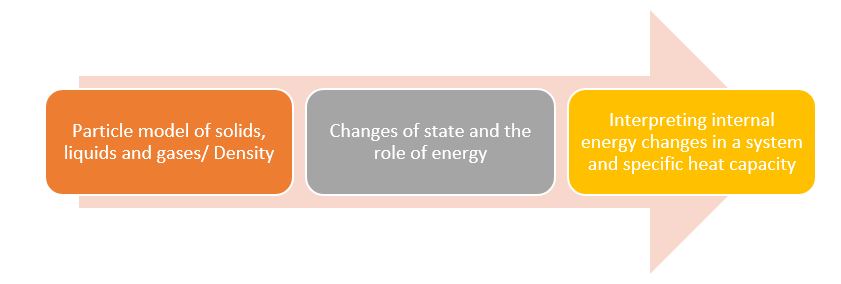
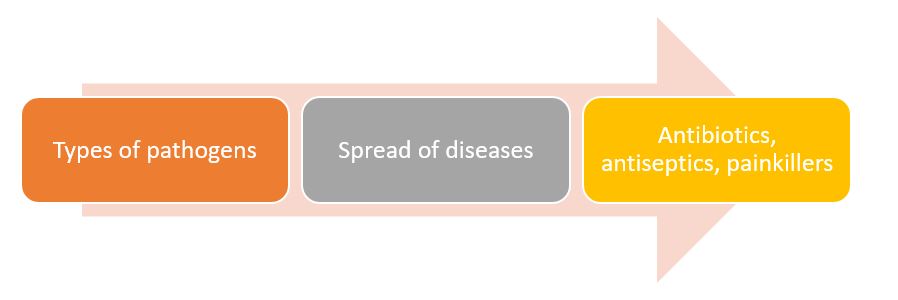
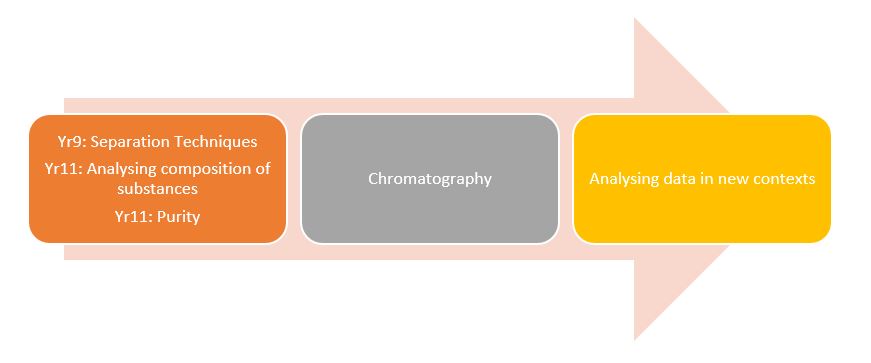
The smart art that I use is the arrow with three separate boxes on it; into this I put the topic for the current learning in the centre box. I then reflect on my planning and complete the first box with the links to previous learning (I then use retrieval practice strategies to ensure students have this expected baseline of understanding, and reteach any gaps as necessary). Finally into the final box, I add where this is leading to; this is usually the most challenging box to write, and it can vary from being a scientific concept that will be learned in the future, to a real world context.
The key to then succeeding with these has then been how these are executed in the lesson; being ready to elaborate on what each box means; often through questioning of students to contribute the prior knowledge section and then taking their responses and linking the new and future learning to it. If done carefully students will feel like they are already a significant way along their Learning Journey to their ultimate goal.
Some examples of the smart art I have used include:
When teaching the first lessons of Atomic Structure in Physics:

When teaching Changes of State in the Particle Model of Matter topic:
When teaching Infectious Diseases at KS3:
When teaching Chromatography in the Chemical Analysis topic:
What I have found in using these images when introducing learning goals and success criteria is that I am quickly able to instil confidence in the students. Knowing that what they are going to be learning today is linked to something they already know, and using the start of a lesson to retrieve this knowledge has the effect of engaging them in sharing information and makes the new knowledge less daunting.
I have also noticed increased engagement from students, for example, the class who were studying atomic structure and isotopes, started thinking about where their learning was going to lead and started asking questions about radioactivity and what they are going to find out in future lessons.
Students have also been much clearer in articulating their learning journey, they refer to the diagram as a prompt, but they are now able to say with greater certainty, what they are learning, how it links to previous knowledge, and the purpose of the lesson and their learning. It has also had a great impact on my on planning and teaching; I also have greater clarity of the learning journey, I think more widely about the sequence of learning that is going to take place and am able to act more responsively as I formatively assess student knowledge and secure understanding before progressing.
References and Further Reading.
- https://www.assessmentforlearning.edu.au/professional_learning/modules/learning_intentions/learning_intentions_landing_page.html
- https://www.aitsl.edu.au/docs/default-source/feedback/aitsl-learning-intentions-and-success-criteria-strategy.pdf?sfvrsn=382dec3c_2
- https://www.oregon.gov/ode/educator-resources/assessment/Documents/writing_tips_learning_goals_success_criteria.pdf
- https://www.rsc.org/cpd/resource/RES00001480/effective-learning-objectives-and-criteria/RES00001476
- http://files.hbe.com.au/samplepages/112002.pdf
- http://bb.plsweb.com/pln/course_documents/1097b36aab1eeb1874260e6170c64ae1.pdf
- https://www.learningscientists.org/blog/2017/10/4-1
- https://www.stem.org.uk/resources/elibrary/resource/273227/john-hattie-learning-intentions-and-success-criteria
 Educating Melon
One thought on “Learning Goals and Success Criteria”